The appearance of drooping, heaviness, or fatigue around the eyes is one of the most common concerns patients bring to NassifMD Plastic Surgery. But the cause is not always what it appears to be, and treating the wrong structure leads to results that fall short, or worse, make the situation harder to correct.
Why Getting the Diagnosis Right Is the Entire Foundation of Treatment
There is a meaningful difference between a patient whose upper eyelids carry excess skin that droops over the lash line and a patient whose brow has descended far enough to push an otherwise normal amount of eyelid tissue into a position of heaviness. To the untrained eye, and sometimes even in photographs, these two presentations can look nearly identical. But they require completely different surgical solutions.
The Importance of the Right Surgery
Performing upper eyelid surgery on a patient whose problem is primarily brow descent does not solve the problem. The brow continues to push tissue downward, results are short-lived, and the patient often returns dissatisfied. Conversely, performing a brow lift on a patient who simply has excess eyelid skin may over-elevate the brow into an unnatural position without meaningfully improving the eyelid appearance.
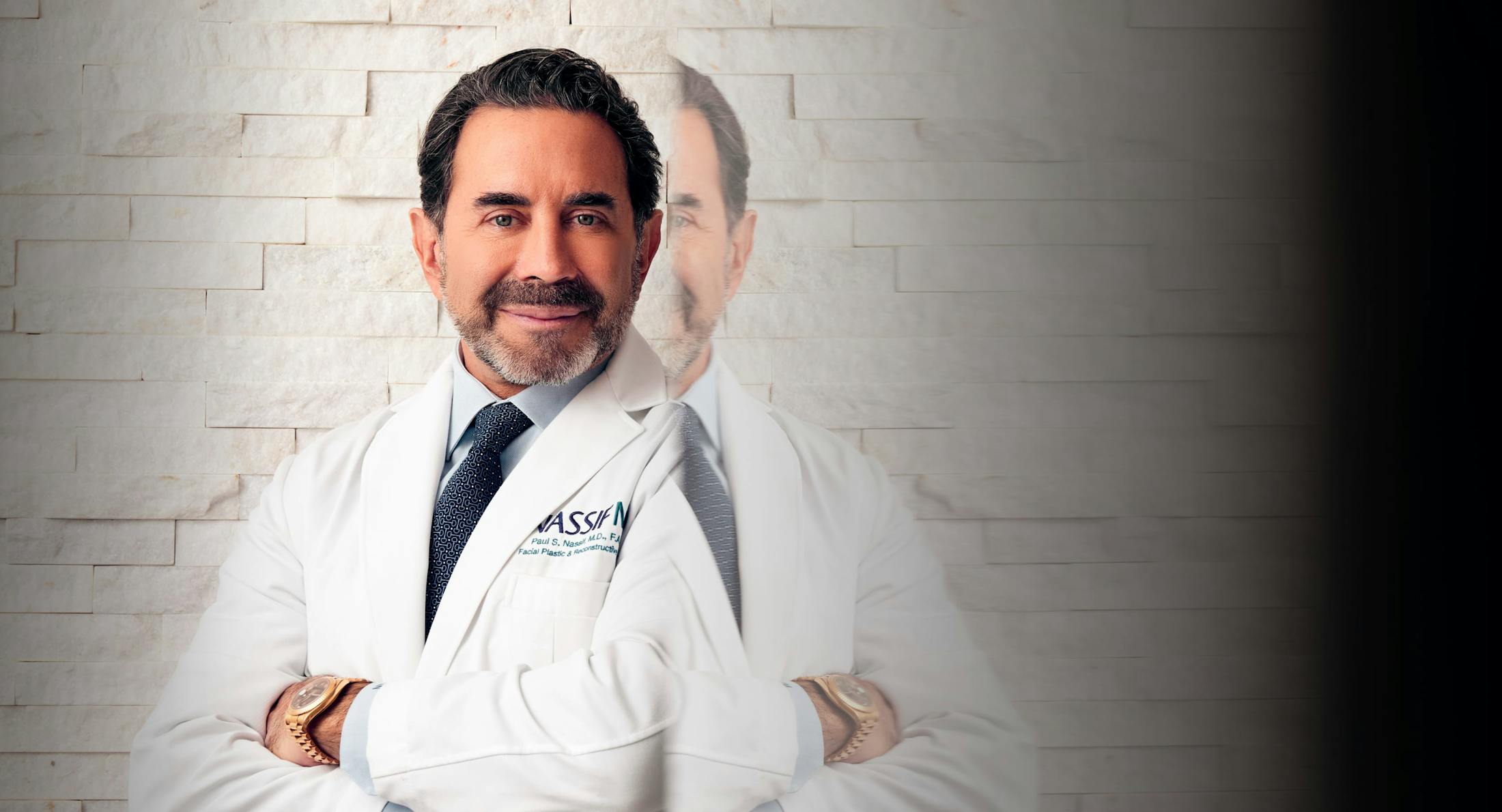
At NassifMD, Dr. Paul Nassif brings decades of experience in facial plastic and reconstructive surgery to these evaluations. His double board certification, his reputation as one of the world's leading facial plastic surgeons, and his role on E!'s Botched, where he regularly corrects the results of misdiagnosed and poorly executed prior surgeries, give him a perspective on this distinction that few surgeons can match.
What Can Actually Cause a Heavy, Tired, or Drooping Appearance Around the Eyes
Several distinct anatomical issues can produce the same general complaint. Understanding which one is present, or which combination, is what shapes the treatment plan.
Excess Upper Eyelid Skin (Dermatochalasis)
This is the most straightforward presentation. The upper eyelid itself carries more skin than it can accommodate without drooping. The eyelid margin may partially obscure the lash line, and the crease of the upper eyelid may be difficult to see. In true dermatochalasis, the brow is appropriately positioned and the problem is localized to the lid itself.
Upper blepharoplasty addresses this directly by removing a carefully measured amount of skin and, when indicated, a small portion of the underlying fat pad. When performed correctly on the right patient, it is one of the most consistently satisfying procedures in facial plastic surgery.
Brow Descent
The brow descends with age as the forehead skin loses elasticity, the brow depressor muscles progressively overpower the frontalis, and the soft tissue of the lateral brow loses support. As the brow falls, it pushes whatever is above the eyelid downward into the lid space. The eyelid itself may have a completely normal amount of skin, but the weight of the descended brow creates the appearance of excess.
Patients with brow descent often subconsciously compensate by chronically elevating their brows using their forehead muscles. This creates forehead lines and can cause fatigue-related headaches. One of the most telling signs during a clinical examination is asking the patient to relax their forehead completely. When the brow drops and the heavy appearance suddenly worsens, brow descent is a significant contributor.
True Ptosis
Distinct from both of the above, true ptosis is a drooping of the upper eyelid margin itself caused by weakness or dysfunction of the levator muscle that lifts the lid. This is not a cosmetic issue in origin. It can be congenital, acquired through aging or injury, or related to other conditions. It requires a specific surgical repair to the levator mechanism and is not corrected by skin removal alone.
Screening for ptosis before planning any upper eyelid or brow procedure is essential. Missing it leads to an incomplete result and a patient who still does not feel that their eyes look open or alert after surgery.
A Combination of All Three
In many patients, particularly those in their late forties and beyond, some degree of each issue is present simultaneously. The art of the evaluation is determining which is the primary driver, which is a secondary contributor, and in what proportion each should be addressed surgically.
This is where the experience of the evaluating surgeon matters enormously. A less experienced surgeon may identify one problem and treat it without recognizing the others. The result is a patient who sees partial improvement and remains unsatisfied without understanding why. At NassifMD, Dr. Nassif's evaluation accounts for all contributing factors before any surgical plan is formed.
How Dr. Nassif Evaluates the Periorbital Area
At NassifMD, the evaluation of a patient presenting with upper eyelid or brow concerns begins with a careful clinical examination that goes well beyond simply looking at photographs.
Dr. Nassif assesses brow position relative to the orbital rim, the presence and depth of the upper eyelid crease, the amount of skin above the crease and the amount below, and the position of the lid margin relative to the pupil. He performs the manual lift test, elevating the brow to its anatomically youthful position with a finger or instrument and observing how much of the eyelid heaviness resolves with that maneuver.
He evaluates asymmetry carefully, as most patients have meaningful differences between their two sides that must be accounted for in the surgical plan. And he screens for ptosis, assessing levator function and lid excursion before any operative planning begins.
What Treatment Looks Like When the Diagnosis Is Accurate
When Upper Eyelid Surgery Is the Answer
Blepharoplasty at NassifMD is performed with meticulous attention to how much skin is removed. The measurement matters more than most patients realize. Removing too little produces a suboptimal result. Removing too much creates lagophthalmos, the inability to fully close the eyelid, which is a serious complication. Dr. Nassif's surgical planning accounts for the natural tension of the skin, the position of the brow, and the amount of tissue needed for comfortable eyelid closure.
When a Brow Lift Is the Answer
A brow lift at NassifMD repositions the descended brow to its anatomically appropriate position, relieving the weight it places on the upper eyelid and restoring a more alert, rested appearance. Dr. Nassif uses techniques that elevate the brow naturally without over-correcting, avoiding the perpetually surprised look associated with aggressive older techniques.
When Both Are Needed
Combining a brow lift and upper blepharoplasty requires careful planning. The amount of eyelid skin removed must account for the elevation the brow lift will achieve. Performing both procedures without that integrated planning risks removing too much eyelid skin when the brow is subsequently elevated, which can compromise closure.
This integrated planning is where Dr. Nassif's decades of experience in facial plastic surgery produce outcomes that less experienced surgeons cannot reliably replicate.
Starting With an Honest Evaluation at NassifMD
If you are bothered by a heavy, drooping, or tired appearance around your eyes and are considering surgical correction, the most important first step is an evaluation that actually distinguishes between what is driving the appearance.
At NassifMD Plastic Surgery in Beverly Hills and Newport Beach, Dr. Paul Nassif takes the time to make that evaluation thoroughly and honestly before any treatment is discussed. He will address your questions and concerns and help you achieve the look you desire. Contact NassifMD to schedule your consultation today.