The under-eye area is one of the most requested treatment zones in facial rejuvenation and one of the most unforgiving. Get it right and the result is a patient who looks genuinely refreshed. Get it wrong and the result is either no improvement, a puffy or bluish discoloration, or the overfilled, pillow-faced appearance that has become a recognizable sign of poorly executed aesthetic treatment.
Why the Tear Trough and Under-Eye Hollow Are So Difficult to Treat
The tear trough is the groove that forms at the junction of the lower eyelid and the cheek. It deepens with age as the fat pads of the midface descend, as the orbital rim loses the soft tissue cushion that once padded it, and as the skin becomes thinner and more translucent. The result is a hollow, shadowed appearance beneath the eyes that makes patients look tired, gaunt, or older than they feel.
Challenging Anatomy
The anatomy here is unforgiving for several reasons. The skin is among the thinnest on the face, meaning any filler placed too superficially, in too great a volume, or with a product that absorbs water readily becomes visible, palpable, and in some cases discolored. The Tyndall effect, a bluish hue caused by light scattering through a superficial hyaluronic acid deposit, is a complication seen frequently in inexperienced hands.
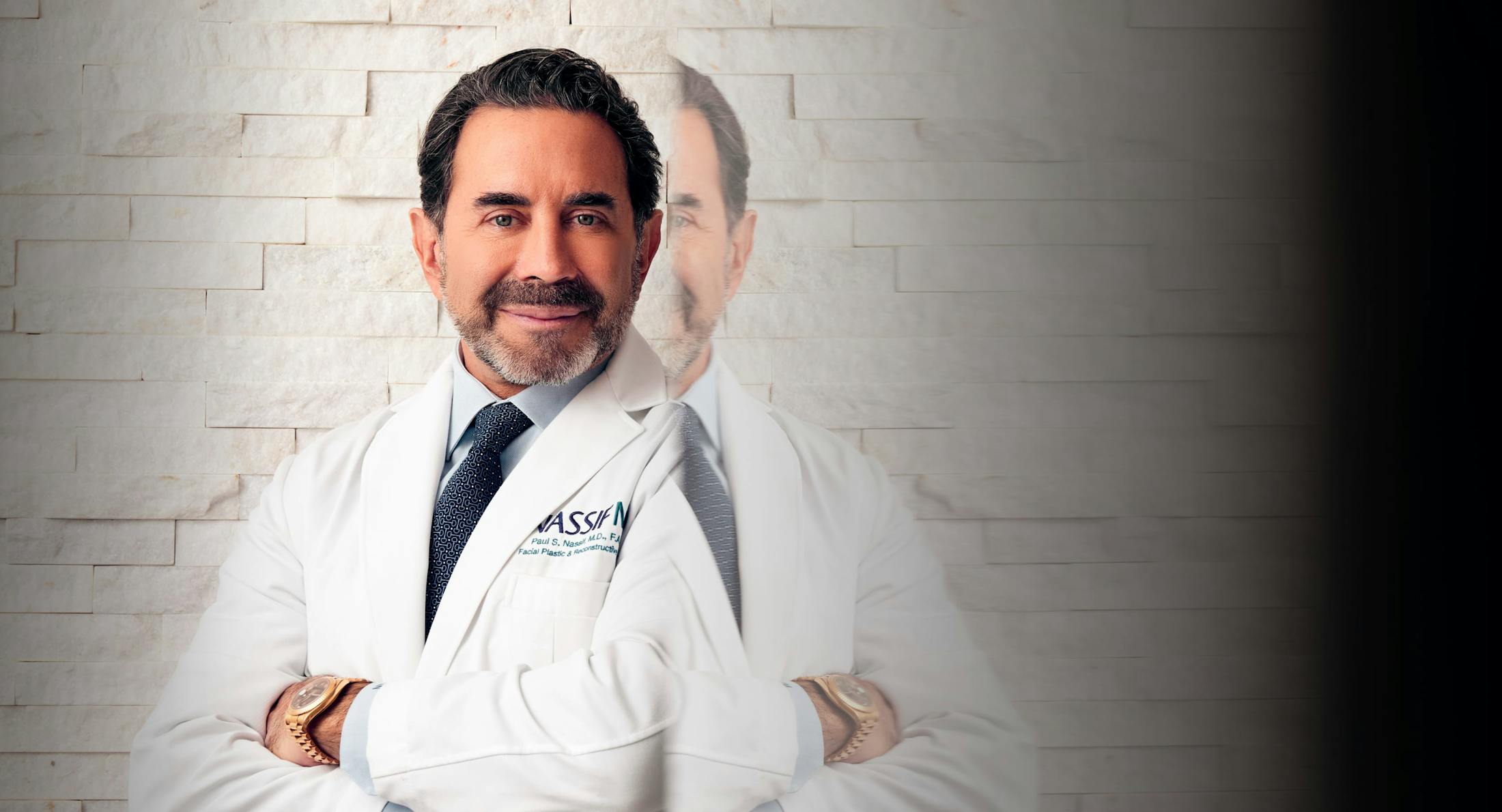
At NassifMD Plastic Surgery, Dr. Paul Nassif approaches the tear trough and under-eye hollow with a level of anatomical precision that reflects his decades of experience as a double board-certified facial plastic and reconstructive surgeon. The question he brings to every under-eye consultation is not simply what to inject, but what the patient actually needs and whether fat grafting is a better answer than temporary filler.
Hyaluronic Acid Fillers vs. Fat Grafting: Understanding the Difference
What Hyaluronic Acid Fillers Do Well
For patients with mild to moderate under-eye hollowing and good skin quality, hyaluronic acid fillers placed precisely in the correct tissue plane can produce a meaningful improvement with no downtime and no surgery. Products like Restylane are commonly used in this area and, in the right hands, can last a year or more.
The advantages of filler in this area include reversibility with hyaluronidase, no surgical recovery, and immediate visible results. For patients who are not ready for surgery or who want to trial the improvement before committing to a more permanent solution, filler can be an appropriate starting point.
Where Fillers Fall Short
The limitations of filler in the under-eye area are real and become more apparent as the degree of hollowing increases.
Hyaluronic acid absorbs water, which can cause the treated area to look swollen or puffy in certain lighting or after sleeping. In thin-skinned patients, even well-placed filler can be visible as a slight roll or ridge under the skin. The correction is temporary, typically requiring repeat treatment every one to two years, and with each repeat treatment the risk of product accumulation and irregular texture increases over time.
For patients with significant volume loss, a descended midface, or very thin skin, filler simply cannot provide the volume needed without looking overfilled or creating an unnatural contour.
Why Fat Grafting Can Be the Better Answer
Surrounding Tissue Integration
Facial fat grafting uses the patient's own fat, harvested from another area of the body, processed, and injected in small, precise deposits into the tear trough and adjacent under-eye hollow. Because the transferred fat is the patient's own biological tissue, it integrates into the surrounding structures in a way that hyaluronic acid cannot.
A Natural Look
Fat does not absorb water. It does not create a Tyndall effect. Once stabilized after the initial reabsorption phase, the surviving fat is permanent. And when placed by a surgeon with the anatomical knowledge and technical precision to deposit it in exactly the right plane and in exactly the right amount, it produces a result that looks natural, feels natural, and does not require maintenance.
Biological Advantage
There is also a biological advantage that goes beyond simply replacing lost volume. Fat contains growth factors and stromal cells that have been shown to improve the quality of the surrounding tissue over time, including skin thickness and texture in the treated area. For patients with very thin, translucent under-eye skin, this secondary benefit can produce a meaningful improvement in the skin itself, not just the contour beneath it.
How Dr. Nassif Approaches Fat Grafting to the Under-Eye Area
The Harvesting Process
Fat is harvested from a donor site, typically the abdomen, flanks, or inner thighs, using gentle liposuction. The amount harvested for the under-eye area is small. This is not a body contouring procedure. It is a precision volumization procedure where the total fat volume transferred to the under-eye area may be measured in fractions of a milliliter per side.
Processing and Preparation
Once harvested, the fat is processed to remove excess fluid, blood, and non-viable cells. Dr. Nassif uses techniques that prioritize the viability of the fat cells, as the survival rate of transferred fat is directly related to how carefully it is handled between harvest and injection.
Placement: Where Precision Matters Most
The under-eye area has multiple distinct tissue planes, and the plane in which fat is placed determines the result. Fat placed too superficially in thin skin looks lumpy or visible. Fat placed too deeply may not produce the surface improvement the patient needs. Dr. Nassif's approach involves placing fat in small, sequential passes that build the correction gradually and allow for even distribution across the hollow.
The goal is never maximum volume. It is the precise volume needed to fill the hollow without overcorrecting, creating a smooth, continuous contour from the lower eyelid to the cheek.
What Recovery Looks Like After Under-Eye Fat Grafting
Recovery from fat grafting to the under-eye area involves more visible swelling and bruising than filler injections, which is one of the reasons not every patient chooses this approach. Most patients can expect:
- Significant swelling in the first week, particularly in the morning
- Bruising that resolves over ten to fourteen days
- A period of two to four weeks before the area begins to look like the intended result
- Final results not fully assessable until three to six months after the procedure, as the fat stabilizes and integrates
Patients who are willing to tolerate this recovery in exchange for a permanent result that does not require maintenance are typically very satisfied with the outcome. Patients who need minimal downtime are often better served by filler in the short term.
Is Under-Eye Fat Grafting Right for You?
The answer depends on the degree of your hollowing, the quality and thickness of your skin, whether you have had prior filler in this area, and whether you are undergoing other facial procedures at the same time.
Dr. Nassif often combines fat grafting to the under-eye area with a facelift or lower eyelid surgery, since addressing the under-eye hollow as part of a comprehensive facial rejuvenation produces the most balanced, natural result. Your consultation at NassifMD will include an honest assessment of which approach is right for your specific anatomy and goals.
To schedule a personalized fat grafting consultation at NassifMD Plastic Surgery in Beverly Hills or Newport Beach, contact our office today.